Listen to this story:
By Clara Atallah
Would we have the courage to question a path to which we have devoted years? Not simply to change direction, but because deep down, we sense that we may be called elsewhere.
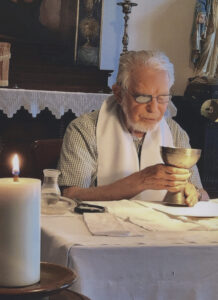
At the age of 40, Fr. Gilles Beauchemin, SJ, had just submitted his doctoral dissertation in physics when he presented his provincial superior with a project of an entirely different nature: to go live in Quebec City’s Lower Town. Not simply to work for the poor, but to live among them.
Yet nothing seemed to foreshadow such a change of direction. Having entered the Society of Jesus in 1957 at the age of 21, Fr. Beauchemin had embarked on a long spiritual and intellectual formation. After four years, with the approval and encouragement of his superiors, he turned to the physical sciences, continuing his studies through a doctoral program and beyond. A career as a researcher lay ahead of him. But a call from the Lord would gradually steer his life in a different direction. Fr. Beauchemin chose to draw closer to the poor and to those whom society often overlooks, not only to serve them but to share life with them.
Perhaps he had not yet realized just how much this proximity would transform him as well.
Allowing Himself to Be Evangelized
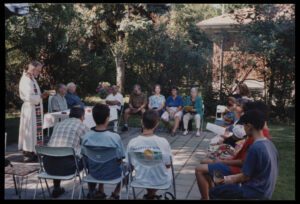
In 1976, his apartment on Caron Street, in the Saint-Roch neighbourhood, became both an open house and a place of prayer. There, Fr. Gilles celebrated Mass with neighbours and socially committed individuals. Marginalized people, former prisoners and people with physical disabilities also began to knock on his door. He accompanied and welcomed people with their stories, their wounds and their experience of God.
“Their presence transformed my prayer,” he wrote. This sentence speaks to his entire vocation. For him, poverty was not a problem to be observed from the outside, but a reality he was willing to engage with — and allow himself to be moved by. Fr. Bernard Carrière, SJ, who knew him during his formation and offered him spiritual accompaniment at the end of his life, believes that Fr. Beauchemin was “evangelized” by the poor: through their experience of insecurity, their way of life and their relationship with God. “It was as if he found God by being close to the poor,” he said.
This insight was further underscored at L’Arche, where Fr. Beauchemin lived for more than four years in a community home, and then again at Maison Dauphine, where he worked with young people living on the streets. In the chapel at Maison Dauphine, he celebrated Mass “with great joy,” even when the congregation was sparse. He saw profound meaning in the fact that this house of welcome for troubled youth was also, in everyone’s eyes, “the house of God.”
Presence Through Prayer
Sent to Haiti in 2001, Fr. Beauchemin found the same vocation there within a more challenging reality. As superior of the Jesuit community, he accompanied Haitians in formation and developed a network of benefactors to provide financial assistance to families. But the aid provided was not the whole story. What mattered most was remaining alongside a people who faced precarious circumstances and discouragement.
“My presence in Haiti also finds its meaning for me in this twofold aspect: being immersed in a sea of misery and being compelled to pray — otherwise, it would be despair,” he wrote in 2009. Prayer did not allow him to escape suffering; it gave him the strength to not look away. It became the very condition of his presence, when solutions remained insufficient and hope could not rest on immediate results.
Embracing Vulnerability
Fr. Carrière sums up Fr. Beauchemin’s legacy with the words: “a transformative presence.” Transformative, no doubt, for those who found in him an openness, a listening ear or support. But it was also Fr. Beauchemin who was transformed, insofar as he received from the poor a knowledge of God that books and studies alone could not provide.
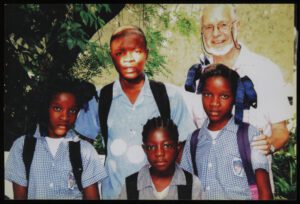
This journey also prepared him for the final stage of his life. Suffering from diabetes and Parkinson’s disease, and finding it increasingly difficult to see, Fr. Beauchemin had to learn to embrace his own vulnerability. He who had chosen to be close to the weak now had to recognize the poor and the suffering within himself. Yet he remained in touch with many people and continued his spiritual accompaniment. The poverty he had discovered in others now taught him to accept his own limitations.
In a text titled “Who Is Poor in Spirit?” written in 1978, Fr. Beauchemin put into words a message that, nearly 50 years later, would come to resonate deeply with his own life.
Who is poor in spirit if not the one who does not reject the child within himself, who does not rebuff the sick, the poor, and the weak who dwell within him, but who grants them a place and a voice? Blessed is that person! Through tears and anguish perhaps, through aridity and loneliness surely, this person will have traveled a long journey that led him to an unexplored region of himself. … He will have discovered the God of Jesus Christ, the God of the poor, the God of the weak and the little ones, the God of the weary and the wounded. He will have discovered a God who is close to us.