By Fannie Dionne
By the end of 2026, the Archives of the Jesuits of Canada (AJC) will have made available online the descriptions and digitized versions of all manuscripts dating from the 17th and 18th centuries in the Archives Collection of Collège Sainte-Marie (CACSM). These are the first digitized documents to be made available online by the AJC.
Among these unique documents of great historical importance, some pertain to the Canadian martyr saints, patrons of the Jesuits of Canada.
François Dansereau, director of the AJC, explains the significance of this work: “One of our goals is to make the archives more accessible to Jesuits and the public, and this work on the CACSM helps achieve that. Online access to these digitized documents also encourages new perspectives on important resources that bear witness to the various activities of the Jesuits in the 17th and 18th centuries.”
Miraculous Healings and Lives of the Saints
Thanks to the AJC team, we can now view online, among other things, deeds of concession of seigneuries, unpublished Jesuit Relations, letters, petitions and hymns.
Some of these manuscripts stand out for their spiritual value. For example, an account of the life and death of St. René Goupil, SJ, (Q-1.86.2) was written around 1642 by St. Isaac Jogues, SJ.
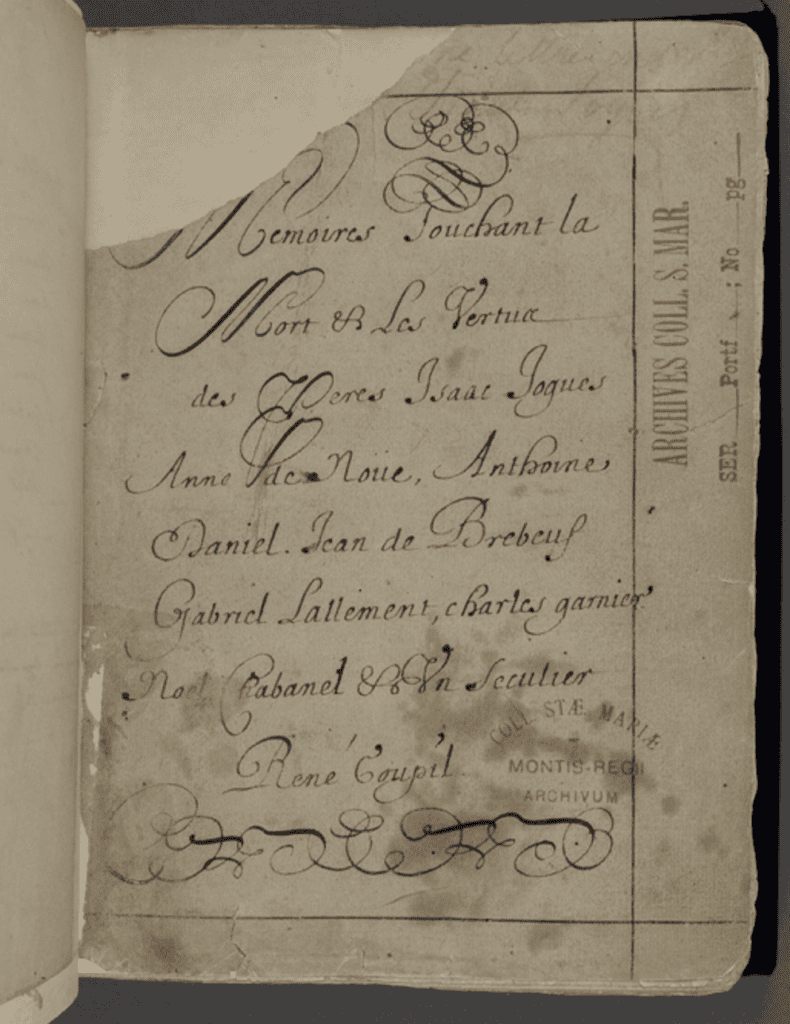
Three manuscripts dated 1663 (Q-1.257) recount the miraculous healing of the servant Barbe Hallay through the intercession of a relic of St. Jean de Brébeuf, SJ. The AJC also holds a document from 1652 written by Paul Ragueneau, SJ, titled “Memoir Concerning the Death and Virtues of Fathers Isaac Jogues, Anne de Noüe, Anthoine Daniel, Jean de Brébeuf, Gabriel Lallement, Charles Garnier, Noël Chabanel, and a Layman, René Goupil” (Q-1.202).
These documents provide insight into the lives of our patron saints through the very words of their companions.
From Paper to an Online Database
To make the CACSM manuscripts accessible on AToM (Access to Memory, an online database), the AJC team undertook a lengthy process.
Historian Fannie Dionne first reviewed and, in some cases, adjusted the list of original documents compiled by intern Riley Wallace in 2020, working on one manuscript at a time. Processing archivist Patricia Prost then ensured that the description of each item was structured according to archival standards before their publication on AToM.
“Structuring the entries properly according to standards is important for providing access points to researchers so they can find the content that interests them,” she explains.
Digitizing more than a hundred documents one page at a time — whether with a camera or a scanner — takes time, explains archivist Christiane Desjardins. It is this painstaking work that now allows researchers to access fragile documents without damaging them. “Digitization also improves readability, as it’s possible to enlarge the sometimes minuscule handwriting thanks to the high resolution of the scans.” Ms. Desjardins also points out that processing all the manuscripts one by one ensures they are preserved under the best conditions for the future.
The CACSM’s historical documents are in high demand among researchers, which explains the digitization and dissemination efforts to make them accessible. However, Ms. Prost notes that this work will not extend to all of the AJC’s archives, as there are significant costs associated with digitization, hosting and making the materials available online. Nevertheless, AToM allows users to view lists of collections processed in recent years, such as those from Collège Saint-Ignace, the Holy Cross Mission and Collège Jean de Brébeuf.
A Brief History of the Jesuit Archives
The CACSM contains only a fraction of the Jesuit manuscripts from the 17th and 18th centuries. Due to the Conquest of 1763 and the suppression of the Society of Jesus worldwide in 1773, the missionaries — with no one to succeed them — passed away one after another, until the death of the last Jesuit, Fr. Jean-Joseph Casot, SJ, in 1800. Before his death, he transferred part of his archives and books to individuals or institutions close to the Jesuits. The most valuable documents (including, among other things, the skull of Jean de Brébeuf, the life of Catherine Tekakwitha, and the Mémoire touchant la Mort & Les Vertus) were entrusted to the Augustinian Hospitallers of Quebec City. The rest was seized by the government and subsequently dispersed.
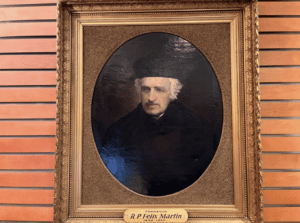
When the Jesuits returned to Canada in 1842, Fr. Félix Martin, SJ, reestablished the Archive of the Jesuits of Canada with the help of the Augustinian Hospitallers, who returned most of the items in their custody.
Fr. Arthur Jones, SJ, continued Fr. Martin’s work by acquiring or receiving several ancient documents, which were placed in safekeeping in the archives of the brand-new Collège Sainte-Marie in Montreal. The Jesuit archivists were able to recover only a fraction of their manuscripts dating from before 1800, but they studied them in detail to, for example, identify their authors and historical context.
Today, digitization allows us to see part of this painstaking work by the early Jesuit archivists, explains Ms. Prost. “The title pages they created, which include metadata and descriptions of the documents, are somewhat the precursors to the cataloging we do today using a digital platform. Several people worked on the old documents. When looking at the original document, the notes and various transcriptions, it’s interesting to see how they’ve changed over time.”