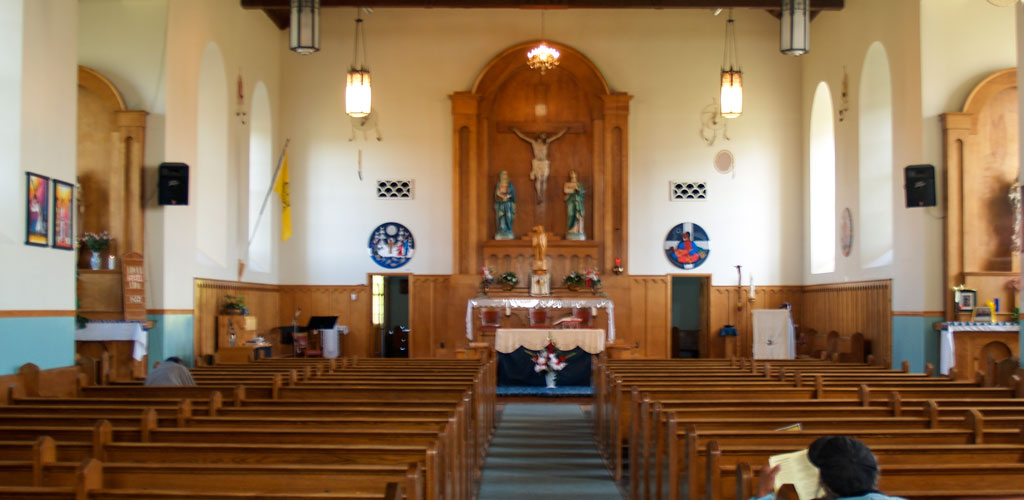
Originally built in 1852 on the Wikwemikong Native Reserve, Holy Cross is the oldest Catholic Church in Northern Ontario.
Holy Cross Mission is the oldest Catholic Church in Northern Ontario. Construction began in 1849 and the Holy Cross Parish and Ruins were officially dedicated on July 25th, 1852. All the mason work during construction was done by Anishinaabe labour. The work for hauling stones was done by men, women and children from all over the community and was indeed backbreaking, however, the Anishinaabe were no strangers to hard labour.
In 1850, a community mill was used for cutting timber into boards for the church construction crew. The principal constructors of the Wikwemikong church were Bemanakinong, Wakegijig, Gabow, and Kenogameg (Kinoshameg) Native families.
In 1954 the Church, Hall and residence were destroyed by a fire. Immediately after this tragedy, local businessmen and trades people from Wikwemikong planned, financed, and re-built this historic church. The parish records and most of the items were saved by the alertness of some parishioners. Only the stone walls remained. The building between the church and residence were demolished and removed. The remains of the old church are still standing on their original site, beside the new church (as can be seen in the above photo).
Holy Cross Mission and the Wikwemikong Reserve are located on Manitoulin Island, where the first Jesuit and European, Fr. Joseph Poncet, SJ, set foot in 1648. He was the last Jesuit to minister on the island until 1845, when the Jesuits returned and have continued their Native ministry since.